
Archaeological Sites in France - Normandy
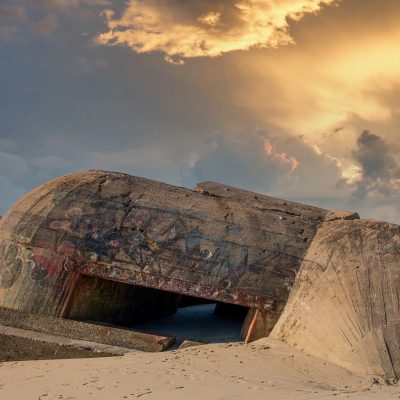
As any visitor to Normandy will attest, fields of cows and orchards full of apple trees are everywhere. This northwestern region attracts many visitors to the memorials and monuments of the D-Day Beaches of World War 2, not far from the city of Caen. Rouen was one of the largest and richest cities of Medieval Europe. Normandy is divided in two, Upper Normandy (2 departments: Eure and Seine Maritime) and Lower Normandy (3 departments: Calvados, Manche and Orne).
- List of Sites
- Sites on a Map
Contents
Roman - Medieval - Museum/Theme Park - UNESCO World Heritage
Roman
The Roman Empire originally centred around the city of Rome in Italy, going on to dominate the Mediterranean region as well as southeastern and southwestern Europe. Roman amphitheatres, temples, towns and villas can still be visited throughout this region today. > Read more
Gisacum
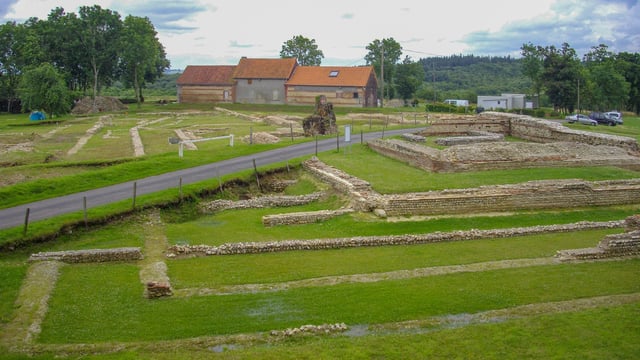
The small rural town of Vieil-Évreux today is more or less at the centre of what was once a large Roman religious settlement. Typical of religious settlements of this kind, there are three main features, a theatre, a temple and thermal baths - it is the thermal baths that have been recently excavated and restored. Although known as Gisacum, this is a recent name. > Read more
Lillebonne Roman Amphitheatre
Lillebonne is located on the north banks of the Seine River. From the first to the third centuries AD the town, then called Juliobona by the Romans - a homage to Julius Cesar, was a very prosperous port. The relatively well preserved Roman amphitheatre is all that remains from these times. The Roman town was abandoned at the end of the third century when it was invaded by barbarians. > Read more
Valognes Roman Baths
The present day town of Valognes was built near the Gallo-Roman town of Alauna (or Alaunia) - on the Roman road between the towns of Cosedia (today Coutances) and Coriallo (today Cherbourg). All that remains from the Roman occupation of the area are the well preserved foundations of a substantial public bath-house. The foundations were revealed in their entirety during excavations in 1989. > Read more
Vieux-la-Romaine
During the 1st century AD, Aregenua (present-day Vieux) became the capital of the Viducasse tribe. Situated at the crossroads of two Roman roads, running north-south and east-west, it became an important commercial staging town. Aregenua and Lillebonne are the only two capital towns in Gallo-Roman Normandy that did not become Medieval towns. A number of buildings have been excavated; but those of a villa, with a hypocaust floor, are open to the public. > Read more
Medieval
The Medieval period in Europe saw the rise of regional kingdoms following the collapse of the Roman Empire in the 5th century AD. Numerous market towns, fortified towns, towers and ramparts, castles, and churches, embodying the archaeology of this time, are still in use today. > Read more
Jumièges Abbey
The picturesque ruins of the Jumièges Abbey have been described as the most beautiful ruins in France. Although founded in the 7th century, that abbey was destroyed in 942 AD by the Vikings. What we visit today are the ruins of the church and monastery consecrated in 1067, in the presence of William the Conqueror, and destroyed during the French Revolution. > Read more
Mont Saint Michel
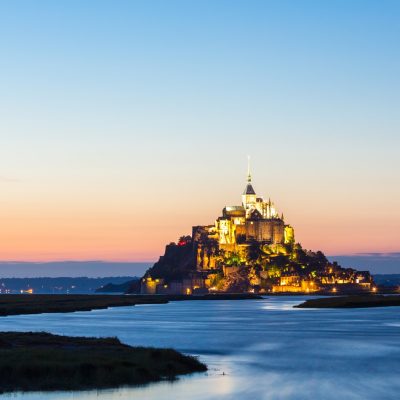
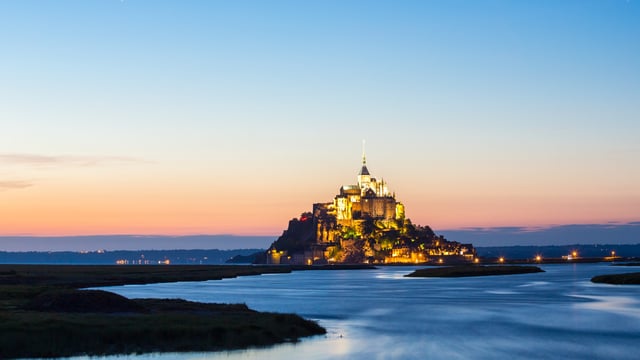
Mont Saint Michel is a village and abbey that really is unlike that of any other. Medieval builders were constrained by the natural pyramidal shape of the granite outcrop, and so created an abbey in three stories, known as La Merveille. At the very top is the abbey church and cloisters, which are made possible by a series of underlying crypts and buttresses. > Read more
Mortemer Abbey
L'Abbaye de Mortemer, a former Cistercian monastery built on land given to the order by Henry I of England, is said to be the most haunted abbey in France. The ruined cloisters are all that survive from the original abbey built in 1134, which were already in disrepair in the 15th century. During the 17th century the abbey was rebuilt, and these buildings are now very well preserved, as is the 17th century dovecote. The monastery was dissolved during the French Revolution. > Read more
Museum/Theme Park
Archaeology is presented to the public in a variety of museums and theme parks. These range from smaller local museums, which tend to exhibit the artefacts from a nearby site, to the national museums that display a broader picture based on larger, more regionally based collections. > Read more
Bayeux Tapestry
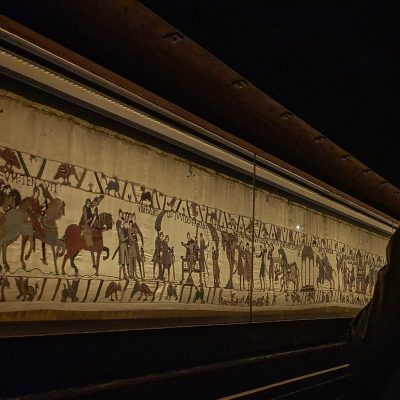
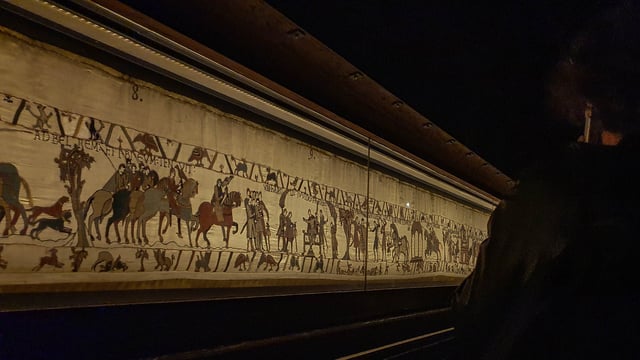
The Bayeux Tapestry is neither a tapestry nor was it made in Bayeux. It is a 70 metre long embroidery made in the 11th century that tells the story of the conquest of England by William, Duke of Normandy. Thought to have been commissioned by the Bishop of Bayeux, Odo - William's half brother, there is however no agreement on where it was made. > Read more
Normandy Museum
Housed in an old Governor's mansion within the Caen Castle, the Musée de Normandie is a typical regional museum. The collections range from the very first Palaeolithic inhabitants of what is now Normandy to the arrival of industry in the region. On display in this grand sweep of history are some truly spectacular artefacts from each period of Normandy's past. > Read more
The Departmental Museum of Antiquities
This museum was established in 1831 specifically to receive and display the wonderful objects recovered from the excavations of Gallo-Roman sites in Lillebonne. Since then it has become the departmental museum of antiquities for the Seine Maritime Department of Upper Normandy. Now, with numerous and varied collections, this museum tells the history of Upper Normandy from the Bronze Age to the Renaissance. > Read more
The Municipal Museum of Lillebonne
Located in the old Town Hall, directly opposite the Gallo-Roman amphitheatre, the Musée municipal de Lillebonne houses a rich collection of Gallo-Roman artefacts from the surrounding area, including some of the objects recovered from the amphitheatre itself. Besides the Roman collections, the museum also has some interesting objects of historical and ethnographic interest from the area. > Read more
Vieux-la-Romaine
During the 1st century AD, Aregenua (present-day Vieux) became the capital of the Viducasse tribe. Situated at the crossroads of two Roman roads, running north-south and east-west, it became an important commercial staging town. Aregenua and Lillebonne are the only two capital towns in Gallo-Roman Normandy that did not become Medieval towns. A number of buildings have been excavated; but those of a villa, with a hypocaust floor, are open to the public. > Read more
UNESCO World Heritage
A number of archaeological sites have been identified by UNESCO as having outstanding cultural significance. As of 2011, there was a total of 911 UNESCO World Heritage Sites of which over 500 are archaeological sites or regions from all periods of the past. > Read more
Mont Saint Michel
Mont Saint Michel is a village and abbey that really is unlike that of any other. Medieval builders were constrained by the natural pyramidal shape of the granite outcrop, and so created an abbey in three stories, known as La Merveille. At the very top is the abbey church and cloisters, which are made possible by a series of underlying crypts and buttresses. > Read more
Google map loading ...
Services
- Basse Copette Two vacation rentals (gites) and B&B in a rural hamlet on the Normandy/Picardy border (2 - 3 bedrooms). Swimming pool. Meals are available.
- Vacation Rentals in France
Resources
-
Rough Guide to Brittany - Normandy
(Amazon.com)
-
Rough Guide to Brittany - Normandy
(Amazon.co.uk)